


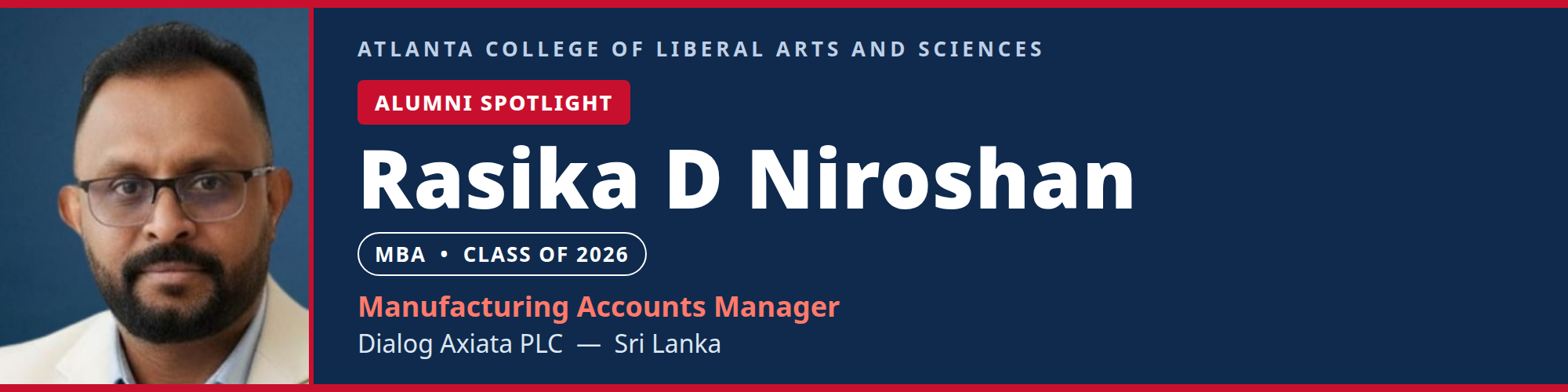
In finance, the numbers either reconcile or they do not. Rasika D Niroshan has spent many years in the finance field, most recently as Manufacturing Accounts Manager at Dialog Axiata PLC in Sri Lanka — work where inventory valuation, costing, and compliance are not background tasks but the business itself. In 2026 he added an MBA from ACLAS to a Bachelor of Commerce and a career built on getting those numbers right. His story is about what a working finance professional does with further study: not a change of direction, but a strengthening of the judgement the job already demands.
"My MBA journey at ACLAS was a rewarding experience that helped me grow both professionally and personally. As someone with many years of experience in the finance field, I wanted to strengthen my management and leadership skills, and the MBA program provided exactly that."
— Rasika D Niroshan, MBA, as featured on his Alumni Spotlight poster
Numbers that have to be right
The first theme of Niroshan's story is accuracy at scale. His own account of his career is unusually concrete: inventory valuation and landed costing for more than 5,000 SKUs, with stock accuracy improved by 15% across manufacturing and warehouse operations; an inventory portfolio exceeding SAR 85 million, managed with accurate valuation, reconciliation, IFRS compliance, and strong financial controls; and a high level of audit readiness across KSA operations, achieved by enhancing internal controls and compliance processes.
Those are not abstract achievements. In manufacturing, a wrong valuation ripples — into pricing, into purchasing, into what the business thinks it owns. Getting 5,000-plus items right, and keeping them right under audit, is the kind of work that is invisible when it succeeds and expensive when it fails. It is also the kind of work where study has to earn its place: a framework is only useful if it survives contact with a real ledger.
That is the test his account applies to the MBA. He did not go looking for a new career. With many years in finance behind him, he wanted to strengthen his management and leadership skills — and, in his words, the programme provided exactly that. The degree was a tool for the job he already had, not an exit from it.
Systems that make the numbers work
The second theme is what happens when accuracy meets systems. Niroshan led the implementation of Microsoft Dynamics 365, cutting processing delays by 30% and improving reporting efficiency — and he supervised finance operations, budgeting, and financial reporting alongside it. A new system does not make the numbers right by itself; it makes the right numbers reachable faster, and visible to the people who need them. His account describes exactly that link: better systems, better reporting, and the actionable inventory, costing, and profitability insights that support strategic leadership decisions.
That link is also where his account of the study itself becomes specific. What he appreciated most, he writes, was the practical approach to learning. Discussions with lecturers and fellow students from different industries gave him new perspectives and helped him connect theory with real workplace situations. The programme challenged him to think more strategically and improved his confidence in making business decisions.
For a finance manager, that is the point of the exercise. Theory that cannot be connected to a workplace situation is a cost; theory that changes how a decision is made is an asset. His account says the knowledge and insights he gained continue to benefit his career today — a claim that is easy to make and, in his case, is backed by the work he describes.
For readers considering the same path
If you are a working professional wondering whether further study is realistic alongside a demanding job, Niroshan's story offers three practical takeaways — not as advice from him, but as what his example demonstrates:
- Study to strengthen the job you have, not to escape it. The most useful degree for an experienced professional is one aimed at the work already in front of them — management and leadership skills applied to real decisions, not a fresh start.
- Judge learning by whether it connects to real work. Discussions with people from other industries, and theory tested against workplace situations, are what turn study into something usable. If a course cannot survive that test, it will not survive the working week either.
- Let systems carry the accuracy. Better reporting and stronger controls are not paperwork — they are what let a finance team move from counting to advising. Study that improves how decisions get made is worth more than study that only adds a credential.
None of this makes the path easy. It makes it possible — which, for a working professional, is the real question.
Want to be our next Alumni Spotlight?
Niroshan's story was first shared on ACLAS's LinkedIn page in September 2026. If you are an ACLAS graduate with a story to share, you can submit yours through the Alumni Spotlight page at spotlight.aclas.college — new graduates are invited to take part, and selected stories will be featured here.
The MBA is $89 one-time, 8 courses, 120 credits, 1–3 years self-paced and 100% online — see https://aclas.college/programs/mba. Entry needs a bachelor's degree or equivalent and the ability to study in English; no IELTS/TOEFL, GPA, work-experience, GMAT or age requirement stated. 2- and 4-instalment plans are available.
Recent Post
Popular Programs
Master of Business Administration
The MBA program is designed to provide students with the essential skills and credentials necessary for career advancement in business management and leadership. It is a quick and cost-effective way to boost your resume and reach your career goal.
Doctor of Business Administration
The Doctor of Business Administration (DBA) program is meticulously designed for professionals aspiring to be leaders in their own right within the business they are involved in. Unlike the PhD programme, the Online DBA is carefully designed to fill the scholar’s journey with key elements that can make an impact on their careers and on the stakeholders they deal with.The program offers an advanced curriculum blending theoretical insights with practical applications, equipping graduates for strategic decision-making and research-oriented roles.
Master of Computer Science
The Master of Computer Science (MCS) program at Atlanta College of Liberal Arts and Sciences (ACLAS) offers a robust, affordable, and flexible education tailored to meet the demands of today’s tech industry. With a unique blend of theoretical and practical learning, the program equips students with the skills and knowledge needed to excel in computer science, while offering a specialized focus on healthcare applications and industry-relevant technologies.
Bachelor of Business Administration
The Bachelor of Business Administration (BBA) at ACLAS College is a comprehensive online undergraduate program that builds foundational knowledge across management, marketing, finance, and strategy. Study at your own pace and earn a U.S. bachelor's degree from anywhere.
Bachelor of Science in Computer Science
This Bachelor of Science in Computer Science Online Video Degree Program features 12 core professional courses structured into a clear, four-stage learning path—spanning programming fundamentals, system architecture, network engineering, and advanced AI & distributed systems. Blending academic rigor with modern industry practices, the program helps learners build a solid, full-stack computer science foundation and system-level computational thinking without the pitfalls of fragmented learning.
Mini-MBA Certificate
A 100% online Mini-MBA program covering the essential pillars of modern business: management, strategy, finance, analytics, operations, and organizational leadership.
Executive Certificate in Project Management
Build practical project management capability for planning, leading, adapting, and delivering projects with greater confidence and organizational impact.
Executive Certificate in Innovation Management
Develop the mindset and tools to lead innovation, manage change, and guide digital transformation. This 100% online certificate program combines design thinking, innovation management, change leadership, and digital business transformation.
Executive Certificate in Financial Management
Build essential financial fluency for business decision-making. This 100% online certificate program covers financial concepts, accounting principles, performance analysis, and investment fundamentals.
Executive Certificate in Strategic Management
Develop strategic thinking for organizational growth, competitive positioning, operational alignment, and leadership decision-making.
Executive Certificate in Global Governance
Understand the political, legal, economic, and sustainability forces shaping global institutions, international cooperation, and cross-border decision-making.
Executive Certificate in Sustainable Business
Explore how sustainable business, ethical decision-making, innovation, and long-term development shape responsible organizations and future-ready leadership.
Professional Certificate in Business Analytics
Build practical analytics capability for business decision-making. This 100% online certificate program covers business analytics, data science, databases, and applied machine learning.
Professional Certificate in Artificial Intelligence
Build a practical foundation in artificial intelligence, machine learning, data science, and large language models for modern business and technology environments.
Executive Certificate in Digital Transformation
Develop the business, innovation, analytics, and digital economy foundations needed to understand and lead digital transformation initiatives.
Professional Certificate in Marketing Strategy
Build a practical foundation in marketing strategy, customer understanding, brand communication, and market-focused business growth.
Executive Certificate in International Business
Build a practical foundation in international business, global markets, cross-border communication, and the legal and economic forces shaping global commerce.
Executive Certificate in Operations Management
Build practical operations capability for improving processes, aligning execution with strategy, managing projects, and using analytics to support better operational decisions.
Professional Certificate in Human Resource Management
Build a practical foundation in human resource management, organizational behavior, team development, and workplace communication.
Executive Certificate in Risk Management
Build practical capability to identify risk, manage uncertainty, respond to crisis, and support ethical and resilient organizational decision-making.
Executive Certificate in Business Law
Build a practical foundation in business law, ethics, international legal principles, and risk management for responsible organizational decision-making.
Executive Certificate in Entrepreneurship
Build a practical foundation for launching, managing, and growing ventures through strategy, innovation, finance, and marketing.
Professional Certificate in Economics
Build a practical foundation in economic reasoning, markets, policy, macroeconomic forces, microeconomic behavior, and the digital economy.
Professional Certificate in Cybersecurity
Build a practical foundation in cybersecurity, cloud computing, database systems, and software engineering for modern digital environments.
Professional Certificate in Cloud Computing
Build a practical foundation in cloud computing, software engineering, database systems, and computer security for modern digital infrastructure.
Professional Certificate in Blockchain Business
Build a practical foundation in blockchain, digital transformation, internet business, and investment concepts for emerging digital markets.
Executive Certificate in Corporate Governance
Build a practical foundation in corporate governance, business ethics, legal awareness, risk management, and organizational behavior.
Professional Certificate in Data Science
Build a practical foundation in data science, databases, machine learning, and programming concepts for modern analytical and technology-driven work.
0 comments