Low-Carbon Education • Paperless Ecosystem • Digital Sobriety

Environmental Sustainability

"We pledge to lead the transition to a low-carbon education model, ensuring that the pursuit of knowledge protects the planet it seeks to improve."

Our Climate Philosophy: The Digital Dividend

ACLAS was engineered to be a Regenerative Institution. By removing the carbon-heavy overhead of physical campus operations and international travel, we offer an elite learning model that aligns with the global drive for net-zero emissions.

Our Green Framework

Four Pillars of Sustainable Learning

We utilize technology to decouple academic excellence from environmental degradation.

1. Zero-Commute Impact (Transportation De-carbonization)

By educating students in 150+ nations through a 100% online model, we avoid thousands of tons of annual CO2 emissions generated by student and faculty travel.

2. Digital Sobriety & Carbon-Neutral Infrastructure

We practice "lean digital design"—optimizing our code to reduce energy consumption per student. We prioritize hosting partners committed to 100% renewable energy.

3. Circular & Paperless Operations

Every workflow—from application to graduation—is 100% digital. We utilize blockchain-verified credentials to eliminate the cost of paper and shipping.

4. Regenerative Research & Innovation

We empower our students to be climate leaders. ACLAS funds and supports student research projects focused on solving environmental challenges in their regions.
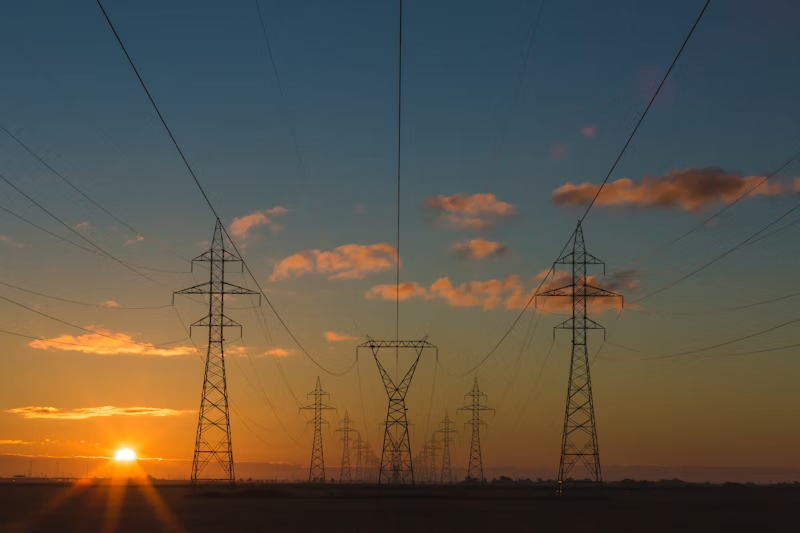
Sustainable Energy Grid
Measuring Our Impact

The Aclas Green Index

Transparency in our environmental stewardship.

85%

Lower Carbon Footprint

Compared to traditional campus-based learning models, according to our Life Cycle Impact assessments.

100%

Paperless Ecosystem

Zero reliance on physical document shipping for core academic credentials and institutional workflows.

40+

Sustainability Modules

Integrating Environmental, Social, and Governance (ESG) standards across our MBA and DBA programs.

Regenerative Education
Curriculum Integration

Education for the Green Transition

We don't just reduce our own footprint; we empower our students to lead sustainable change in their own industries.

  • ESG Leadership Training: Advanced modules for executives on Environmental and Social Governance.
  • Sustainable Supply Chain Policy: Research-led initiatives focusing on circular economy principles.
  • Digital Sobriety Standards: Teaching future CTOs how to build energy-efficient, sustainable digital systems.
  • Climate-Positive Capstones: Encouraging final research projects that solve regional sustainability challenges.
Sustainability FAQ

Climate & Technology

Understanding the environmental impact of digital higher education.

We utilize a Life Cycle Assessment (LCA) approach. We account for server energy, staff remote operations, and estimated student device usage. We contrast this with the "avoided emissions" from eliminating physical travel and campus heating/cooling.

Digital Sobriety is the philosophy of using technology efficiently. For ACLAS, this means writing efficient code, minimizing data storage, and ensuring our platform is as lean as possible, maximizing the climate benefits of our online-only model.

Physical certificates require paper, ink, and international shipping. Our blockchain-verified digital credentials eliminate these processes entirely, offering a zero-carbon alternative that is also more secure and verifiable worldwide.

We are committed to a net-zero future. Our roadmap includes transitioning 100% of our hosting to zero-carbon energy providers by 2028 and expanding our "Regenerative Research" initiatives, where we fund student projects that solve environmental challenges in their home nations.

Learn Without a Footprint. Lead for the Planet.

Join a regenerative education model built for a net-zero future.