


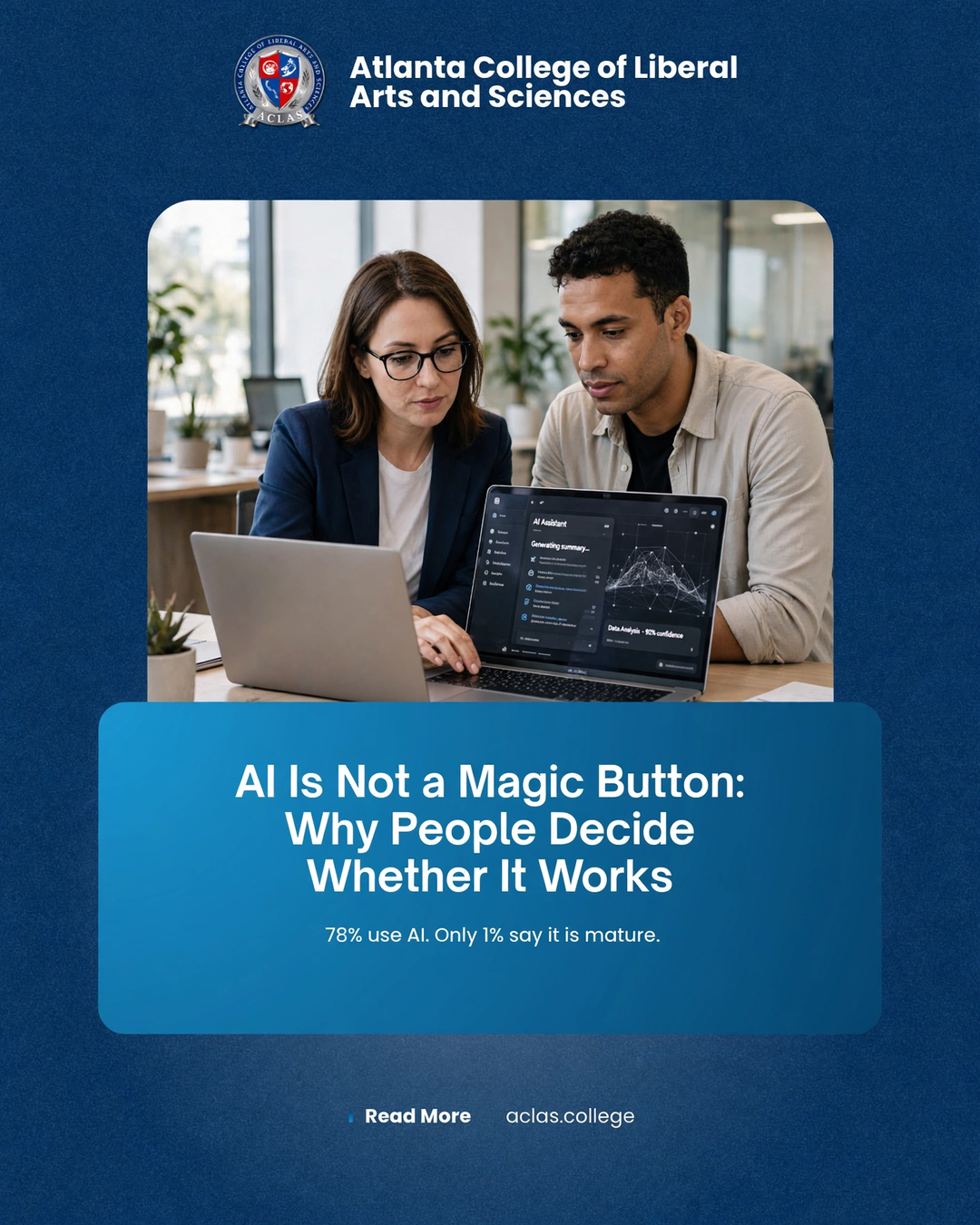
Every few months, a new AI tool arrives with the same promise: install it, and productivity will take care of itself. Leaders buy the software, announce the rollout, and wait for the transformation. Months later, usage is patchy, results are mixed, and the expensive licenses sit mostly idle.
The technology was rarely the problem. The people were, in the sense that people always decide whether a tool becomes part of the work or a distraction from it. McKinsey's latest global survey found that 88% of organizations now use AI in at least one business function, yet only about one-third have begun to scale it across the enterprise. The gap between trying AI and benefiting from it is not a technology gap. It is an adoption gap.
Why good tools get ignored
Employees ignore new tools for predictable reasons. The tool does not fit the way they actually work. Nobody explained what problem it solves for them, only what it does for the company. Training was a single webinar months before the launch. And underneath it all sits a quiet fear: if the tool does my job, what happens to me?
None of these are solved by a better algorithm. They are solved by management. The organizations that get value from AI treat adoption as a change project, not an IT project. They involve the people who do the work in choosing and shaping the tool. They redesign the workflow around it instead of bolting it onto the old one. And they answer the fear directly, with honesty about what will change and what will not.
What successful adoption looks like
Look at teams where AI genuinely helps, and a pattern emerges. The tool is aimed at a specific, painful task, not at "productivity" in general. Drafting the first version of a report. Summarizing a long thread. Checking a spreadsheet for errors. Small, concrete jobs where the benefit is obvious in the first week.
Next, the team is given room to experiment. The first outputs are rough, and everyone knows it. People learn where the tool is strong, where it hallucinates, and where a human still has to be in charge. That learning only happens when mistakes are treated as tuition, not as failure.
Finally, the humans keep the judgment. AI is excellent at generating options and terrible at knowing which option is right for this customer, this patient, this budget. The teams that thrive are the ones that use AI to widen their choices and then apply human judgment to pick. The tool proposes. People dispose.
The numbers tell the same story
McKinsey's survey also found that the biggest barrier to scaling AI is not technology or data. It is leadership and talent. Organizations that redesign workflows and invest in training their people are far more likely to see real gains. Those that simply hand out licenses are not.
That finding should not surprise anyone who has led a team through any change. Tools do not adopt themselves. People adopt tools, when the tool makes their day better, when they were part of the decision, and when they trust that using it will not be held against them.
What this means if you are studying or working now
If you are learning about AI, whether in a computer science program or a management course, learn the human side with the same seriousness as the technical side. Understand how work actually flows in an organization. Learn to ask the people who do a job what slows them down. Practice explaining a tool in terms of the user's day, not the vendor's features.
The professionals who will be most valuable in the AI era are not the ones who can prompt a model the cleverest. They are the ones who can walk into a team, understand the work, and help people adopt new tools without fear. That is a management skill as much as a technical one.
AI is not a magic button. Pressed by a team that trusts it, understands it, and has reshaped its work around it, it is a powerful lever. Pressed by an organization that bought it and hoped, it is an expensive distraction. The difference was never in the button. It was always in the people.
This article is part of a three-part series on leading people: how trust turns employees into leaders and how leaders make every message land.
Study this further
Want to study this further? Atlanta College of Liberal Arts and Sciences (ACLAS) teaches Applied Machine Learning in the MCS ($299 total tuition) and Strategy and Operations in the MBA ($89 total tuition) — 100% online, self-paced, start any time. Learn more: https://aclas.college/programs/mcs and https://aclas.college/programs/mba
Related Reading
- The Transformative Role of AI in Online Learning
- Learn by Doing: Applied Machine Learning at ACLAS
- Why Management Still Matters in the AI Era

Inspired by the SmartBrief article on the key to successful AI adoption. https://www.smartbrief.com/original/the-key-to-successful-ai-adoption-focus-on-the-people
Recent Post

Popular Programs
Master of Business Administration
The MBA program is designed to provide students with the essential skills and credentials necessary for career advancement in business management and leadership. It is a quick and cost-effective way to boost your resume and reach your career goal.
Doctor of Business Administration
The Doctor of Business Administration (DBA) program is meticulously designed for professionals aspiring to be leaders in their own right within the business they are involved in. Unlike the PhD programme, the Online DBA is carefully designed to fill the scholar’s journey with key elements that can make an impact on their careers and on the stakeholders they deal with.The program offers an advanced curriculum blending theoretical insights with practical applications, equipping graduates for strategic decision-making and research-oriented roles.
Master of Computer Science
The Master of Computer Science (MCS) program at Atlanta College of Liberal Arts and Sciences (ACLAS) offers a robust, affordable, and flexible education tailored to meet the demands of today’s tech industry. With a unique blend of theoretical and practical learning, the program equips students with the skills and knowledge needed to excel in computer science, while offering a specialized focus on healthcare applications and industry-relevant technologies.
Bachelor of Business Administration
The Bachelor of Business Administration (BBA) at ACLAS College is a comprehensive online undergraduate program that builds foundational knowledge across management, marketing, finance, and strategy. Study at your own pace and earn a U.S. bachelor's degree from anywhere.
Bachelor of Science in Computer Science
This Bachelor of Science in Computer Science Online Video Degree Program features 12 core professional courses structured into a clear, four-stage learning path—spanning programming fundamentals, system architecture, network engineering, and advanced AI & distributed systems. Blending academic rigor with modern industry practices, the program helps learners build a solid, full-stack computer science foundation and system-level computational thinking without the pitfalls of fragmented learning.
Mini-MBA Certificate
A 100% online Mini-MBA program covering the essential pillars of modern business: management, strategy, finance, analytics, operations, and organizational leadership.
Executive Certificate in Project Management
Build practical project management capability for planning, leading, adapting, and delivering projects with greater confidence and organizational impact.
Executive Certificate in Innovation Management
Develop the mindset and tools to lead innovation, manage change, and guide digital transformation. This 100% online certificate program combines design thinking, innovation management, change leadership, and digital business transformation.
Executive Certificate in Financial Management
Build essential financial fluency for business decision-making. This 100% online certificate program covers financial concepts, accounting principles, performance analysis, and investment fundamentals.
Executive Certificate in Strategic Management
Develop strategic thinking for organizational growth, competitive positioning, operational alignment, and leadership decision-making.
Executive Certificate in Global Governance
Understand the political, legal, economic, and sustainability forces shaping global institutions, international cooperation, and cross-border decision-making.
Executive Certificate in Sustainable Business
Explore how sustainable business, ethical decision-making, innovation, and long-term development shape responsible organizations and future-ready leadership.
Professional Certificate in Business Analytics
Build practical analytics capability for business decision-making. This 100% online certificate program covers business analytics, data science, databases, and applied machine learning.
Professional Certificate in Artificial Intelligence
Build a practical foundation in artificial intelligence, machine learning, data science, and large language models for modern business and technology environments.
Executive Certificate in Digital Transformation
Develop the business, innovation, analytics, and digital economy foundations needed to understand and lead digital transformation initiatives.
Professional Certificate in Marketing Strategy
Build a practical foundation in marketing strategy, customer understanding, brand communication, and market-focused business growth.
Executive Certificate in International Business
Build a practical foundation in international business, global markets, cross-border communication, and the legal and economic forces shaping global commerce.
Executive Certificate in Operations Management
Build practical operations capability for improving processes, aligning execution with strategy, managing projects, and using analytics to support better operational decisions.
Professional Certificate in Human Resource Management
Build a practical foundation in human resource management, organizational behavior, team development, and workplace communication.
Executive Certificate in Risk Management
Build practical capability to identify risk, manage uncertainty, respond to crisis, and support ethical and resilient organizational decision-making.
Executive Certificate in Business Law
Build a practical foundation in business law, ethics, international legal principles, and risk management for responsible organizational decision-making.
Executive Certificate in Entrepreneurship
Build a practical foundation for launching, managing, and growing ventures through strategy, innovation, finance, and marketing.
Professional Certificate in Economics
Build a practical foundation in economic reasoning, markets, policy, macroeconomic forces, microeconomic behavior, and the digital economy.
Professional Certificate in Cybersecurity
Build a practical foundation in cybersecurity, cloud computing, database systems, and software engineering for modern digital environments.
Professional Certificate in Cloud Computing
Build a practical foundation in cloud computing, software engineering, database systems, and computer security for modern digital infrastructure.
Professional Certificate in Blockchain Business
Build a practical foundation in blockchain, digital transformation, internet business, and investment concepts for emerging digital markets.
Executive Certificate in Corporate Governance
Build a practical foundation in corporate governance, business ethics, legal awareness, risk management, and organizational behavior.
Professional Certificate in Data Science
Build a practical foundation in data science, databases, machine learning, and programming concepts for modern analytical and technology-driven work.
0 comments