



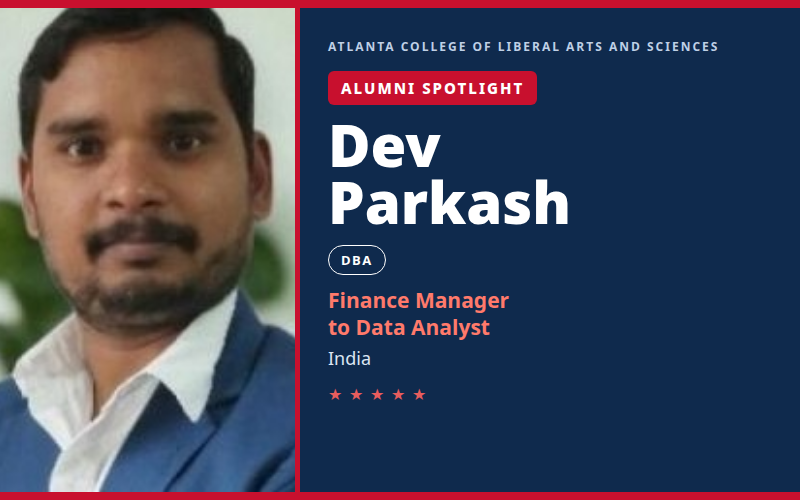
Most career changes start with starting over. Dev Parkash's did not. A finance professional in India with over nine years of experience, he moved from Finance Manager to Data Analyst — then completed a Doctor of Business Administration (DBA) at ACLAS to make the move stick. His story is about a career change built on what came before it, not on walking away from it: the finance knowledge stayed, the analytics were added, and the doctorate tied the two together.
"My DBA from ACLAS strengthened my ability to connect business strategy with data analytics, enabling me to deliver measurable value and guide informed decisions within my organization."
— Dev Parkash, DBA, as featured on his Alumni Spotlight poster
Nine years of finance, pointed in a new direction
The first thing to notice is that his move is not a break with his past. Nine years in finance is a long time to learn how a business actually works: where the money goes, which numbers matter, what a good decision looks like when it has to be paid for. A Finance Manager already knows the questions. The move to Data Analyst added a new way of answering them.
The poster that introduced him puts it plainly: he combined "financial acumen with analytical expertise to drive strategic business insights". Neither half works without the other. Financial acumen alone knows what matters but can only guess at the detail; analytical expertise alone can find patterns but may not know which ones are worth acting on. Together, they drive insight, not just reports.
That is a mid-career change done properly: he did not discard nine years of experience to become a beginner again, but added a skill that made the experience more useful. The finance background lets him tell a meaningful finding from a trivial one; the analytics lets him find it in the first place.
Strategy and analytics, connected
The second theme is the one his own words point to: connection. Parkash does not say the DBA taught him analytics. He says it "strengthened my ability to connect business strategy with data analytics" — a bridge, not a subject: taking a strategic question from the business and turning it into an analytical one, and then turning an analytical answer back into a decision.
That is harder to learn than either side on its own, and it is why a doctorate fits this story. A DBA is a programme about running organisations, not about one technique. For someone who already works with both money and data, its value is in the joining: strategy on one side, analytics on the other, and the judgement to move between them.
And he measures the result the way a finance person would: in value delivered and decisions guided. "Measurable value" is his phrase, and it is a demanding standard — not that the study was interesting, but that it could be seen in the work. "Guide informed decisions within my organization" is the same test from the other side: the learning counts when it changes what the organisation decides. The study earned its place because it showed up at work.
The LinkedIn feature that introduced him makes the same point: business strategy combined with data analysis to produce measurable value. It is a short summary, but it is the whole story — two things he already knew, connected by a programme that taught him to connect them, producing something his organisation could measure.
For readers considering the same path
If you are thinking about a similar move — from one function to another, or from doing the work to understanding it more deeply — his example offers three practical takeaways:
- Build on what you already know. A career change does not have to mean starting from zero. Nine years of finance gave Parkash the questions worth asking; analytics gave him new ways to answer them. The most useful new skill is usually the one that makes your existing experience more valuable, not the one that replaces it.
- Learn to speak both sides' language. Value here comes from the connection, not from either side alone. Strategy without data is guessing; data without strategy is noise. The skill that matters is moving between the two — turning a business question into an analytical one, and an analytical finding into a decision.
- Judge the study by what it lets you deliver. Parkash's test is not whether the programme was interesting, but whether it delivered measurable value and guided real decisions. If you are choosing a programme while working full time, that is the test to apply: will it change anything in your organisation, or only on your CV?
None of this makes the path short. It makes it worth taking — which, for a working professional with nine years already invested, is the real question.
Want to be our next Alumni Spotlight?
Parkash's story was first shared on ACLAS's LinkedIn page around December 2025. If you are an ACLAS graduate with a story to share, you can submit yours through the Alumni Spotlight page at spotlight.aclas.college — new graduates are invited to take part, and selected stories will be featured here.
The DBA is $199 one-time (instalments available: Plan A 4 payments of $30, $40, $50 and $79, plus $2 per payment, $207 total; Plan B 2 payments of $60 and $139, plus $2 per payment, $203 total), 14 courses, 210 credits, 1–3 years self-paced and 100% online — see https://aclas.college/programs/dba. DBA entry needs a master's degree or equivalent and English reading, writing and speaking.
Recent Post
Popular Programs
Master of Business Administration
The MBA program is designed to provide students with the essential skills and credentials necessary for career advancement in business management and leadership. It is a quick and cost-effective way to boost your resume and reach your career goal.
Doctor of Business Administration
The Doctor of Business Administration (DBA) program is meticulously designed for professionals aspiring to be leaders in their own right within the business they are involved in. Unlike the PhD programme, the Online DBA is carefully designed to fill the scholar’s journey with key elements that can make an impact on their careers and on the stakeholders they deal with.The program offers an advanced curriculum blending theoretical insights with practical applications, equipping graduates for strategic decision-making and research-oriented roles.
Master of Computer Science
The Master of Computer Science (MCS) program at Atlanta College of Liberal Arts and Sciences (ACLAS) offers a robust, affordable, and flexible education tailored to meet the demands of today’s tech industry. With a unique blend of theoretical and practical learning, the program equips students with the skills and knowledge needed to excel in computer science, while offering a specialized focus on healthcare applications and industry-relevant technologies.
Bachelor of Business Administration
The Bachelor of Business Administration (BBA) at ACLAS College is a comprehensive online undergraduate program that builds foundational knowledge across management, marketing, finance, and strategy. Study at your own pace and earn a U.S. bachelor's degree from anywhere.
Bachelor of Science in Computer Science
This Bachelor of Science in Computer Science Online Video Degree Program features 12 core professional courses structured into a clear, four-stage learning path—spanning programming fundamentals, system architecture, network engineering, and advanced AI & distributed systems. Blending academic rigor with modern industry practices, the program helps learners build a solid, full-stack computer science foundation and system-level computational thinking without the pitfalls of fragmented learning.
Mini-MBA Certificate
A 100% online Mini-MBA program covering the essential pillars of modern business: management, strategy, finance, analytics, operations, and organizational leadership.
Executive Certificate in Project Management
Build practical project management capability for planning, leading, adapting, and delivering projects with greater confidence and organizational impact.
Executive Certificate in Innovation Management
Develop the mindset and tools to lead innovation, manage change, and guide digital transformation. This 100% online certificate program combines design thinking, innovation management, change leadership, and digital business transformation.
Executive Certificate in Financial Management
Build essential financial fluency for business decision-making. This 100% online certificate program covers financial concepts, accounting principles, performance analysis, and investment fundamentals.
Executive Certificate in Strategic Management
Develop strategic thinking for organizational growth, competitive positioning, operational alignment, and leadership decision-making.
Executive Certificate in Global Governance
Understand the political, legal, economic, and sustainability forces shaping global institutions, international cooperation, and cross-border decision-making.
Executive Certificate in Sustainable Business
Explore how sustainable business, ethical decision-making, innovation, and long-term development shape responsible organizations and future-ready leadership.
Professional Certificate in Business Analytics
Build practical analytics capability for business decision-making. This 100% online certificate program covers business analytics, data science, databases, and applied machine learning.
Professional Certificate in Artificial Intelligence
Build a practical foundation in artificial intelligence, machine learning, data science, and large language models for modern business and technology environments.
Executive Certificate in Digital Transformation
Develop the business, innovation, analytics, and digital economy foundations needed to understand and lead digital transformation initiatives.
Professional Certificate in Marketing Strategy
Build a practical foundation in marketing strategy, customer understanding, brand communication, and market-focused business growth.
Executive Certificate in International Business
Build a practical foundation in international business, global markets, cross-border communication, and the legal and economic forces shaping global commerce.
Executive Certificate in Operations Management
Build practical operations capability for improving processes, aligning execution with strategy, managing projects, and using analytics to support better operational decisions.
Professional Certificate in Human Resource Management
Build a practical foundation in human resource management, organizational behavior, team development, and workplace communication.
Executive Certificate in Risk Management
Build practical capability to identify risk, manage uncertainty, respond to crisis, and support ethical and resilient organizational decision-making.
Executive Certificate in Business Law
Build a practical foundation in business law, ethics, international legal principles, and risk management for responsible organizational decision-making.
Executive Certificate in Entrepreneurship
Build a practical foundation for launching, managing, and growing ventures through strategy, innovation, finance, and marketing.
Professional Certificate in Economics
Build a practical foundation in economic reasoning, markets, policy, macroeconomic forces, microeconomic behavior, and the digital economy.
Professional Certificate in Cybersecurity
Build a practical foundation in cybersecurity, cloud computing, database systems, and software engineering for modern digital environments.
Professional Certificate in Cloud Computing
Build a practical foundation in cloud computing, software engineering, database systems, and computer security for modern digital infrastructure.
Professional Certificate in Blockchain Business
Build a practical foundation in blockchain, digital transformation, internet business, and investment concepts for emerging digital markets.
Executive Certificate in Corporate Governance
Build a practical foundation in corporate governance, business ethics, legal awareness, risk management, and organizational behavior.
Professional Certificate in Data Science
Build a practical foundation in data science, databases, machine learning, and programming concepts for modern analytical and technology-driven work.
0 comments