


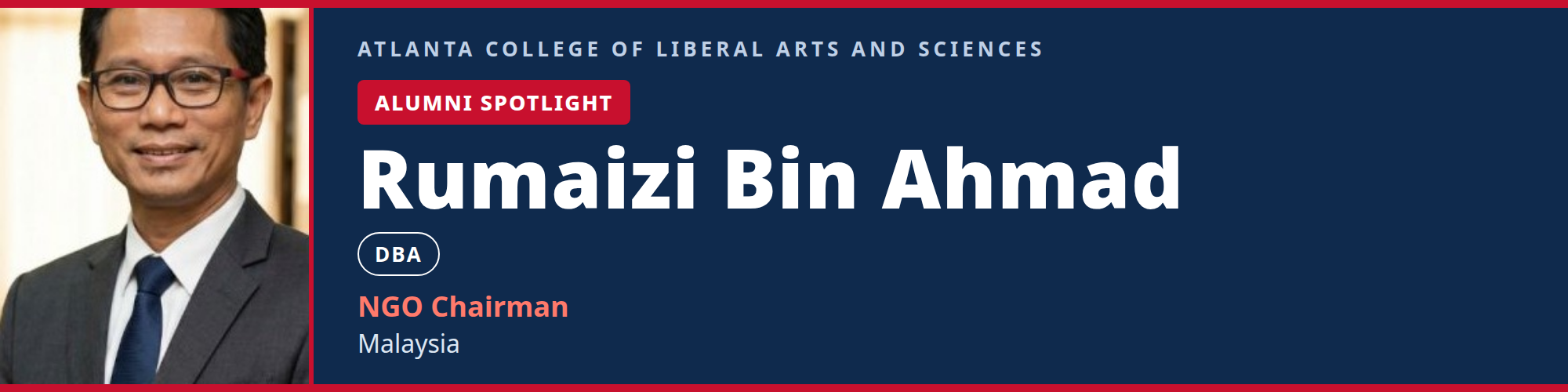
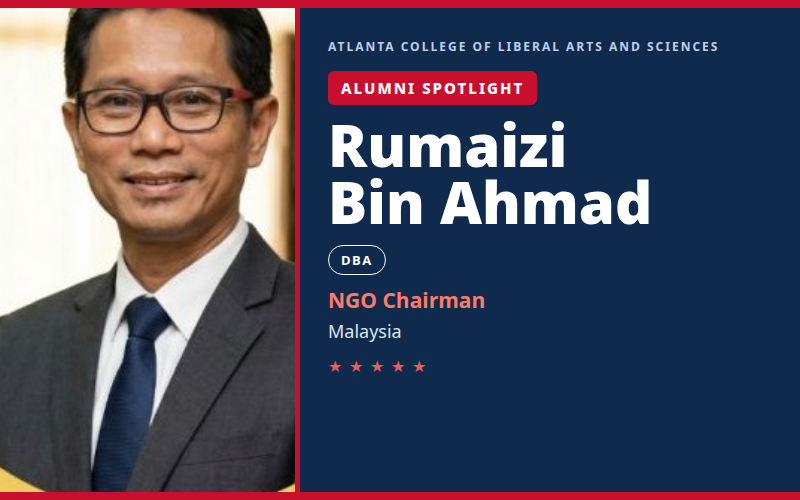
Rumaizi Bin Ahmad has now been featured in this column twice — and this is the earlier of the two. His 2026 feature, published here as blog 99, presents him as NGO Chairperson and District Branch Chairman of a Cooperative, with a first-person account of studying for his Doctor of Business Administration (DBA) alongside a busy working life. This feature came first, published on ACLAS's LinkedIn page around December 2025, on the earlier white, blue and gold poster template — and it presents him in a different light: as chairman of an NGO, leading an organisation with strategic leadership and advancing community development, education, and public discourse. The two features describe the same person from different angles, and they belong together. This post tells the first half of that story.
"As a chairman of an NGO, he has led the organization with strong strategic leadership, advancing community development, education, and public discourse. The advanced leadership training has strengthened his management capabilities, enabling improved governance, strategic planning, and organizational effectiveness. From here, it reflects his commitment to impactful, ethical, and knowledge-driven leadership."
— as worded on his 2025 Alumni Spotlight poster
Strategic leadership that serves a community
The first theme of this feature is leadership measured by what it advances. As chairman of an NGO, Ahmad is described as leading with strong strategic leadership — and the poster is specific about what that leadership is for: community development, education, and public discourse. Those are not the usual language of business success. They are the language of a leader whose organisation exists to serve people outside it, and whose results are counted in communities rather than in profit.
That framing matters, because it sets the standard by which his leadership is judged. A chairman's job is not only to keep an organisation running; it is to decide where it should go, and to carry people with that decision. Community development, education, and public discourse are long, slow kinds of work — they do not produce quick wins, and they cannot be faked. Leading them well takes patience, judgement, and a willingness to be measured by outcomes that take years to appear.
The LinkedIn feature adds the other half of the picture: Ahmad is also a public-school principal with a thirty-year career in education. The two roles are not separate lives. A principal who has spent three decades in schools understands what community development actually looks like on the ground, and an NGO chairman who comes from education brings that understanding to the organisation he leads. Each role makes the other stronger.
Governance, planning, and effectiveness
The second theme is what the training itself did. The poster says the advanced leadership training strengthened his management capabilities, enabling improved governance, strategic planning, and organizational effectiveness. Those three words — governance, planning, effectiveness — are the unglamorous core of running any organisation, and they are exactly what separates a well-meaning NGO from one that delivers.
Governance is accountability: decisions made properly, funds handled openly, and trust kept with the people the organisation serves. Strategic planning is direction: knowing which problems to take on, in what order, with the resources actually available. Organizational effectiveness is delivery: the difference between a plan on paper and a result in a community. For an NGO chairman, none of these is optional, and none of them is learned by instinct alone. They are capabilities, and capabilities can be trained.
The poster closes with the quality that holds the rest together: a commitment to impactful, ethical, and knowledge-driven leadership. Impactful, because leadership that changes nothing is only ceremony. Ethical, because an NGO's authority rests entirely on trust. And knowledge-driven, because good intentions are not enough — decisions have to rest on evidence, on study, and on what is actually known. That is the thread that runs from the classroom of a principal with thirty years of experience to the boardroom of an NGO chairman: leadership as a discipline, learned and practised, not merely a position held.
For readers considering the same path
If you lead an organisation — a school, an NGO, a cooperative, a community group — and you are wondering whether doctoral study is for you, Ahmad's first feature offers three practical takeaways:
- Judge a programme by the capabilities it builds, not the title it confers. Governance, strategic planning, and organizational effectiveness are the working tools of a leader. The right doctorate is one that strengthens those tools, in the organisation you already lead, while you are still leading it.
- Let your two roles teach each other. A principal and an NGO chairman are different jobs, but they draw on the same judgement. Study that connects your roles — rather than asking you to leave one behind for the other — is worth more than study that deepens only a single job.
- Hold yourself to impact, ethics, and evidence. Leadership that is impactful, ethical, and knowledge-driven is a standard you can apply to every decision you make. If a programme helps you meet that standard more often, it has done its job — whatever the certificate says.
None of this makes the path easy. It makes it worth taking — which, for a working leader, is the real question.
Want to be our next Alumni Spotlight?
Ahmad's first feature was shared on ACLAS's LinkedIn page around December 2025; his second feature is already on this blog as post 99. If you are an ACLAS graduate with a story to share, you can submit yours through the Alumni Spotlight page at spotlight.aclas.college — new graduates are invited to take part, and selected stories will be featured here.
The DBA is $199 one-time (instalments available: Plan A 4 payments of $30, $40, $50 and $79, plus $2 per payment, $207 total; Plan B 2 payments of $60 and $139, plus $2 per payment, $203 total), 14 courses, 210 credits, 1–3 years self-paced and 100% online — see https://aclas.college/programs/dba. Entry needs a master's degree or equivalent and English reading, writing and speaking.
Recent Post
Popular Programs
Master of Business Administration
The MBA program is designed to provide students with the essential skills and credentials necessary for career advancement in business management and leadership. It is a quick and cost-effective way to boost your resume and reach your career goal.
Doctor of Business Administration
The Doctor of Business Administration (DBA) program is meticulously designed for professionals aspiring to be leaders in their own right within the business they are involved in. Unlike the PhD programme, the Online DBA is carefully designed to fill the scholar’s journey with key elements that can make an impact on their careers and on the stakeholders they deal with.The program offers an advanced curriculum blending theoretical insights with practical applications, equipping graduates for strategic decision-making and research-oriented roles.
Master of Computer Science
The Master of Computer Science (MCS) program at Atlanta College of Liberal Arts and Sciences (ACLAS) offers a robust, affordable, and flexible education tailored to meet the demands of today’s tech industry. With a unique blend of theoretical and practical learning, the program equips students with the skills and knowledge needed to excel in computer science, while offering a specialized focus on healthcare applications and industry-relevant technologies.
Bachelor of Business Administration
The Bachelor of Business Administration (BBA) at ACLAS College is a comprehensive online undergraduate program that builds foundational knowledge across management, marketing, finance, and strategy. Study at your own pace and earn a U.S. bachelor's degree from anywhere.
Bachelor of Science in Computer Science
This Bachelor of Science in Computer Science Online Video Degree Program features 12 core professional courses structured into a clear, four-stage learning path—spanning programming fundamentals, system architecture, network engineering, and advanced AI & distributed systems. Blending academic rigor with modern industry practices, the program helps learners build a solid, full-stack computer science foundation and system-level computational thinking without the pitfalls of fragmented learning.
Mini-MBA Certificate
A 100% online Mini-MBA program covering the essential pillars of modern business: management, strategy, finance, analytics, operations, and organizational leadership.
Executive Certificate in Project Management
Build practical project management capability for planning, leading, adapting, and delivering projects with greater confidence and organizational impact.
Executive Certificate in Innovation Management
Develop the mindset and tools to lead innovation, manage change, and guide digital transformation. This 100% online certificate program combines design thinking, innovation management, change leadership, and digital business transformation.
Executive Certificate in Financial Management
Build essential financial fluency for business decision-making. This 100% online certificate program covers financial concepts, accounting principles, performance analysis, and investment fundamentals.
Executive Certificate in Strategic Management
Develop strategic thinking for organizational growth, competitive positioning, operational alignment, and leadership decision-making.
Executive Certificate in Global Governance
Understand the political, legal, economic, and sustainability forces shaping global institutions, international cooperation, and cross-border decision-making.
Executive Certificate in Sustainable Business
Explore how sustainable business, ethical decision-making, innovation, and long-term development shape responsible organizations and future-ready leadership.
Professional Certificate in Business Analytics
Build practical analytics capability for business decision-making. This 100% online certificate program covers business analytics, data science, databases, and applied machine learning.
Professional Certificate in Artificial Intelligence
Build a practical foundation in artificial intelligence, machine learning, data science, and large language models for modern business and technology environments.
Executive Certificate in Digital Transformation
Develop the business, innovation, analytics, and digital economy foundations needed to understand and lead digital transformation initiatives.
Professional Certificate in Marketing Strategy
Build a practical foundation in marketing strategy, customer understanding, brand communication, and market-focused business growth.
Executive Certificate in International Business
Build a practical foundation in international business, global markets, cross-border communication, and the legal and economic forces shaping global commerce.
Executive Certificate in Operations Management
Build practical operations capability for improving processes, aligning execution with strategy, managing projects, and using analytics to support better operational decisions.
Professional Certificate in Human Resource Management
Build a practical foundation in human resource management, organizational behavior, team development, and workplace communication.
Executive Certificate in Risk Management
Build practical capability to identify risk, manage uncertainty, respond to crisis, and support ethical and resilient organizational decision-making.
Executive Certificate in Business Law
Build a practical foundation in business law, ethics, international legal principles, and risk management for responsible organizational decision-making.
Executive Certificate in Entrepreneurship
Build a practical foundation for launching, managing, and growing ventures through strategy, innovation, finance, and marketing.
Professional Certificate in Economics
Build a practical foundation in economic reasoning, markets, policy, macroeconomic forces, microeconomic behavior, and the digital economy.
Professional Certificate in Cybersecurity
Build a practical foundation in cybersecurity, cloud computing, database systems, and software engineering for modern digital environments.
Professional Certificate in Cloud Computing
Build a practical foundation in cloud computing, software engineering, database systems, and computer security for modern digital infrastructure.
Professional Certificate in Blockchain Business
Build a practical foundation in blockchain, digital transformation, internet business, and investment concepts for emerging digital markets.
Executive Certificate in Corporate Governance
Build a practical foundation in corporate governance, business ethics, legal awareness, risk management, and organizational behavior.
Professional Certificate in Data Science
Build a practical foundation in data science, databases, machine learning, and programming concepts for modern analytical and technology-driven work.
0 comments