


By ACLAS College
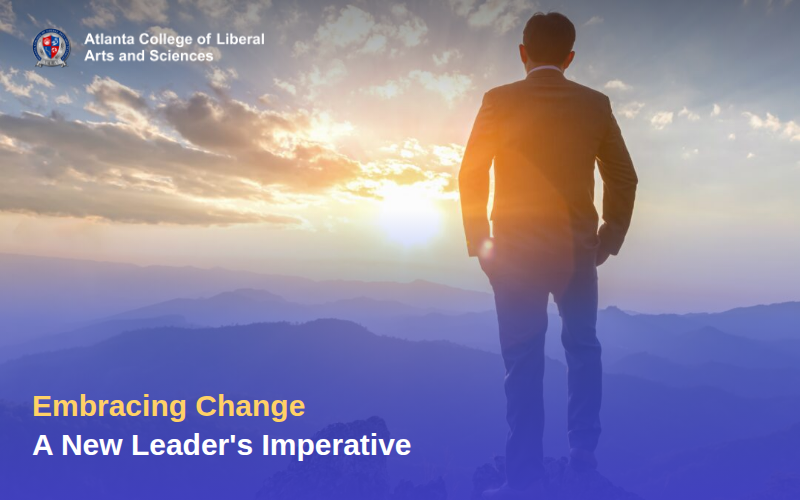
Picture the first month in a new leadership role. The team is watching you. The plan you inherited is already out of date. Somewhere in week three, the company announces a change you did not see coming: a new system, a new structure, a new direction. This is the moment that separates leaders who grow from leaders who stall. Not the announcement itself. What you do next.
Change is the only constant in leadership, and it is the part nobody trains you for. You can study strategy, finance, and operations for years. None of it prepares you for the day the ground moves under your feet and twenty people look at you to see how you will react. The leaders who thrive are not the ones with the best plans. They are the ones who can adapt, learn fast, and bring their teams with them.
The landscape never stops moving
Technology shifts. Markets shift. Customers change what they expect, sometimes in a single year. A leader who stops learning is a leader who slowly becomes irrelevant, and the decline is quiet enough that you might not notice it until it is too late.
Microsoft CEO Satya Nadella put it in a single sentence: "Don't be a know-it-all; be a learn-it-all." It sounds simple. In practice it means walking into rooms where you are not the expert and being comfortable with that. It means asking questions your ego would rather not ask, and treating every change as something to study rather than something to survive.
Netflix is the example everyone cites, and it is worth citing because the pivot was so complete. A DVD rental company looked at how people were starting to watch video and bet the whole business on streaming. That was not a tweak. It was a decision to abandon the thing that made the company successful, before the market forced the issue. The leaders who make that kind of call are not braver than everyone else. They are simply paying closer attention to where the world is going.
Discomfort is part of the job
Change is uncomfortable, and no amount of planning removes that. The leaders who handle it well do not pretend otherwise. They step into the discomfort and let their teams see them doing it.
Sara Blakely, who built Spanx from nothing, has said to embrace what you don't know, especially in the beginning, because what you don't know can become your greatest asset. That is a strange idea to a new leader who feels pressure to have every answer. But it is how learning works. The questions you ask in your first months are the ones that reveal what everyone else stopped noticing years ago.
New leaders should take calculated risks early, while the team is still forming its opinion of them. Approve the small experiment. Let someone try the new approach. Say out loud that you don't know how this will turn out, and that you want to find out together. A team that sees its leader take a risk learns that risk-taking is allowed. A team that sees its leader play it safe learns the same lesson in reverse.
Learn from failure, out loud
Failure is inevitable. The question is whether your team learns from it or hides it.
Elon Musk has said that failure is an option at SpaceX, and that if things are not failing, you are not innovating enough. You do not have to run a rocket company to use that idea. The principle is the same in any team: if nobody ever fails, nobody is trying anything new. And if people are afraid to admit failure, the same mistakes repeat in silence.
The practical move is small. When something goes wrong, talk about it in the open. What did we try? What happened? What do we do differently next time? The first time a leader does this, the room goes quiet. The second time, someone else volunteers their own mistake. By the third time, the team has a habit that most organizations never build: honest, fast learning.
Build a culture that can bend
Adaptability is not a personal trait. It is a property of the team. A leader can be flexible on their own and still run a rigid organization, because the systems around them punish anything new.
Look at what actually gets rewarded. If people are praised for following the process and quietly punished for questioning it, you have a culture that cannot bend, no matter what the values poster says. If people are thanked for flagging a problem early, even when the news is bad, you have a culture that can change direction before the problem becomes a crisis.
Start with the review. After a project ends, ask the team what surprised them, what they would do differently, and what they learned. Make the review about learning, not blame. Over time, those conversations compound into something valuable: a team that treats change as normal work, not as an emergency.
Why most change efforts stall
Here is the number that should sober any new leader. McKinsey's research finds that about 70% of transformation attempts fail. The plans are usually sound. The technology usually works. What fails is the human side: people who were never told why the change mattered, leaders who did not model the new behavior, and incentives that still rewarded the old way of working.
That is actually good news for a new leader. It means the thing that decides whether change works is not the quality of the slide deck. It is whether people believe in the reason, see their leaders living it, and have the skills to do the new thing. Those are all things a leader controls directly, starting on day one.
What this means for working adults
If you are studying management while holding down a job, you do not need a title to practice this. The next time your workplace changes something, a tool, a process, a reporting line, watch how you react. Do you dig in, or do you ask what the change is trying to solve? Try being the person who asks the good question in the meeting instead of the person who quietly resists after it.
Adaptability is a skill, and like any skill it improves with use. Each change you navigate well makes the next one easier, for you and for the people around you. As Jon Kabat-Zinn put it, you can't stop the waves, but you can learn to surf.
This article is part of a five-part series on leading teams: making a difference as a leader right now, building passion in your employees, what employees really want and encouraging employees to keep learning and growing.
Related Reading
- Mastering Hybrid Work Leadership in 2025: Seven Essential Strategies for Business Leaders
- Why Managers Should Involve Their Teams in the Decision-Making Process
- Why Management Still Matters in the AI Era

Recent Post
Popular Programs
Master of Business Administration
The MBA program is designed to provide students with the essential skills and credentials necessary for career advancement in business management and leadership. It is a quick and cost-effective way to boost your resume and reach your career goal.
Doctor of Business Administration
The Doctor of Business Administration (DBA) program is meticulously designed for professionals aspiring to be leaders in their own right within the business they are involved in. Unlike the PhD programme, the Online DBA is carefully designed to fill the scholar’s journey with key elements that can make an impact on their careers and on the stakeholders they deal with.The program offers an advanced curriculum blending theoretical insights with practical applications, equipping graduates for strategic decision-making and research-oriented roles.
Master of Computer Science
The Master of Computer Science (MCS) program at Atlanta College of Liberal Arts and Sciences (ACLAS) offers a robust, affordable, and flexible education tailored to meet the demands of today’s tech industry. With a unique blend of theoretical and practical learning, the program equips students with the skills and knowledge needed to excel in computer science, while offering a specialized focus on healthcare applications and industry-relevant technologies.
Bachelor of Business Administration
The Bachelor of Business Administration (BBA) at ACLAS College is a comprehensive online undergraduate program that builds foundational knowledge across management, marketing, finance, and strategy. Study at your own pace and earn a U.S. bachelor's degree from anywhere.
Bachelor of Science in Computer Science
This Bachelor of Science in Computer Science Online Video Degree Program features 12 core professional courses structured into a clear, four-stage learning path—spanning programming fundamentals, system architecture, network engineering, and advanced AI & distributed systems. Blending academic rigor with modern industry practices, the program helps learners build a solid, full-stack computer science foundation and system-level computational thinking without the pitfalls of fragmented learning.
Mini-MBA Certificate
A 100% online Mini-MBA program covering the essential pillars of modern business: management, strategy, finance, analytics, operations, and organizational leadership.
Executive Certificate in Project Management
Build practical project management capability for planning, leading, adapting, and delivering projects with greater confidence and organizational impact.
Executive Certificate in Innovation Management
Develop the mindset and tools to lead innovation, manage change, and guide digital transformation. This 100% online certificate program combines design thinking, innovation management, change leadership, and digital business transformation.
Executive Certificate in Financial Management
Build essential financial fluency for business decision-making. This 100% online certificate program covers financial concepts, accounting principles, performance analysis, and investment fundamentals.
Executive Certificate in Strategic Management
Develop strategic thinking for organizational growth, competitive positioning, operational alignment, and leadership decision-making.
Executive Certificate in Global Governance
Understand the political, legal, economic, and sustainability forces shaping global institutions, international cooperation, and cross-border decision-making.
Executive Certificate in Sustainable Business
Explore how sustainable business, ethical decision-making, innovation, and long-term development shape responsible organizations and future-ready leadership.
Professional Certificate in Business Analytics
Build practical analytics capability for business decision-making. This 100% online certificate program covers business analytics, data science, databases, and applied machine learning.
Professional Certificate in Artificial Intelligence
Build a practical foundation in artificial intelligence, machine learning, data science, and large language models for modern business and technology environments.
Executive Certificate in Digital Transformation
Develop the business, innovation, analytics, and digital economy foundations needed to understand and lead digital transformation initiatives.
Professional Certificate in Marketing Strategy
Build a practical foundation in marketing strategy, customer understanding, brand communication, and market-focused business growth.
Executive Certificate in International Business
Build a practical foundation in international business, global markets, cross-border communication, and the legal and economic forces shaping global commerce.
Executive Certificate in Operations Management
Build practical operations capability for improving processes, aligning execution with strategy, managing projects, and using analytics to support better operational decisions.
Professional Certificate in Human Resource Management
Build a practical foundation in human resource management, organizational behavior, team development, and workplace communication.
Executive Certificate in Risk Management
Build practical capability to identify risk, manage uncertainty, respond to crisis, and support ethical and resilient organizational decision-making.
Executive Certificate in Business Law
Build a practical foundation in business law, ethics, international legal principles, and risk management for responsible organizational decision-making.
Executive Certificate in Entrepreneurship
Build a practical foundation for launching, managing, and growing ventures through strategy, innovation, finance, and marketing.
Professional Certificate in Economics
Build a practical foundation in economic reasoning, markets, policy, macroeconomic forces, microeconomic behavior, and the digital economy.
Professional Certificate in Cybersecurity
Build a practical foundation in cybersecurity, cloud computing, database systems, and software engineering for modern digital environments.
Professional Certificate in Cloud Computing
Build a practical foundation in cloud computing, software engineering, database systems, and computer security for modern digital infrastructure.
Professional Certificate in Blockchain Business
Build a practical foundation in blockchain, digital transformation, internet business, and investment concepts for emerging digital markets.
Executive Certificate in Corporate Governance
Build a practical foundation in corporate governance, business ethics, legal awareness, risk management, and organizational behavior.
Professional Certificate in Data Science
Build a practical foundation in data science, databases, machine learning, and programming concepts for modern analytical and technology-driven work.
0 comments