Atlanta College of Liberal Arts and Sciences is an online university offering quality education worldwide.

Dive into the fundamental mathematical properties of computer hardware and software with "Automata and Formal Languages." This foundational course uses idealized mathematical models to explore the ultimate capabilities, boundaries, and limitations of computation.

About This Course
Welcome to "Automata and Formal Languages," a foundational computer science course based on Michael Sipser’s renowned textbook, Introduction to the Theory of Computation (Third Edition). This course explores the fundamental mathematical properties of computer hardware, software, and their applications. We will dive into a core question: What are the fundamental capabilities and limitations of computers? Because real computers are too complex to allow for manageable mathematical theories, we will use idealized computational models to understand the essence of computation. By stepping away from the drudgery of specific programming codes, you will discover the genuinely exciting, elegant, and abstract aspects of computer theory.
What You Will Learn
In this course, you will transition from understanding simple computational models to more powerful ones. You will learn to formulate mathematical definitions, theorems, and proofs in a computing context. Key topics include:
Why Take This Course?
You might wonder if theory is arcane or irrelevant to practical programming. In reality, theory is highly relevant to practice! The conceptual tools you learn here are heavily utilized by computer engineers. If you ever design a programming language, your knowledge of context-free grammars will be essential. If you deal with string searching, text processing, or pattern matching, finite automata and regular expressions will be your go-to tools. Furthermore, while specific software technologies become outdated quickly, the ability to think abstractly, solve complex problems, and express yourself precisely has lasting value. This course is designed to expand your mind and heighten your aesthetic sense for building beautiful, efficient systems.
Who Should Take This Course?
This course is designed for Bachelor of Science in Computer Science (BSCS) students, upper-level undergraduates, and introductory graduate students in computer science or engineering. It is intended for anyone who is curious about the mathematical foundations of computers. While previous experience with programming is helpful, the most important prerequisite is a willingness to engage with mathematical notions, logical reasoning, and theorem proving.
Every single course certificate issued by Atlanta College of Liberal Arts and Sciences (ACLAS) is verifiable via our digital registry and is eligible for institutional authentication (Apostille/IECC), ensuring your professional milestones are recognized globally as of 2026.
Dive into the world of problem-solving with our comprehensive course. Explore the art and science of tackling challenges, making informed decisions, and crafting effective solutions. Perfect for individuals seeking to enhance their personal and professional growth.
In this course, you will learn the most important skills and most applicable tools of successful business communication in a fast and efficient way.
Gain a comprehensive understanding of essential financial concepts with the Financial Concepts Course. This transformative program equips participants with the knowledge and skills to make informed decisions in personal and professional financial settings. From risk assessment to investment analysis, explore the tools and strategies that shape financial decision-making.
In this course, you will learn the most important skills and the most applicable tools for a successful strategic operations strategy in a quick and effective way.

This course offers a comprehensive introduction to database engineering, covering fundamental concepts like data storage, relationships, SQL operations, and database normalization. Participants will gain hands-on experience by building a fully operational database and using tools like XAMPP to manage databases locally and remotely.

Master the fundamentals of computer security, from authentication to network defense. This course covers essential topics such as security threats, vulnerabilities, network security protocols, and cryptography.
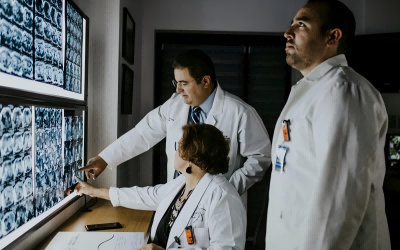
Discover how deep learning can revolutionize healthcare. This course covers essential topics such as health data standards, neural networks, predictive models, and the application of deep learning techniques to healthcare data.

Master the fundamentals and practical applications of machine learning in this hands-on course. From regression techniques to neural networks and model evaluation, learn how to build and optimize machine learning models using real-world datasets.